The nursery did not start as a building. It started as a decision about where the water would run, and where the shade would fall.
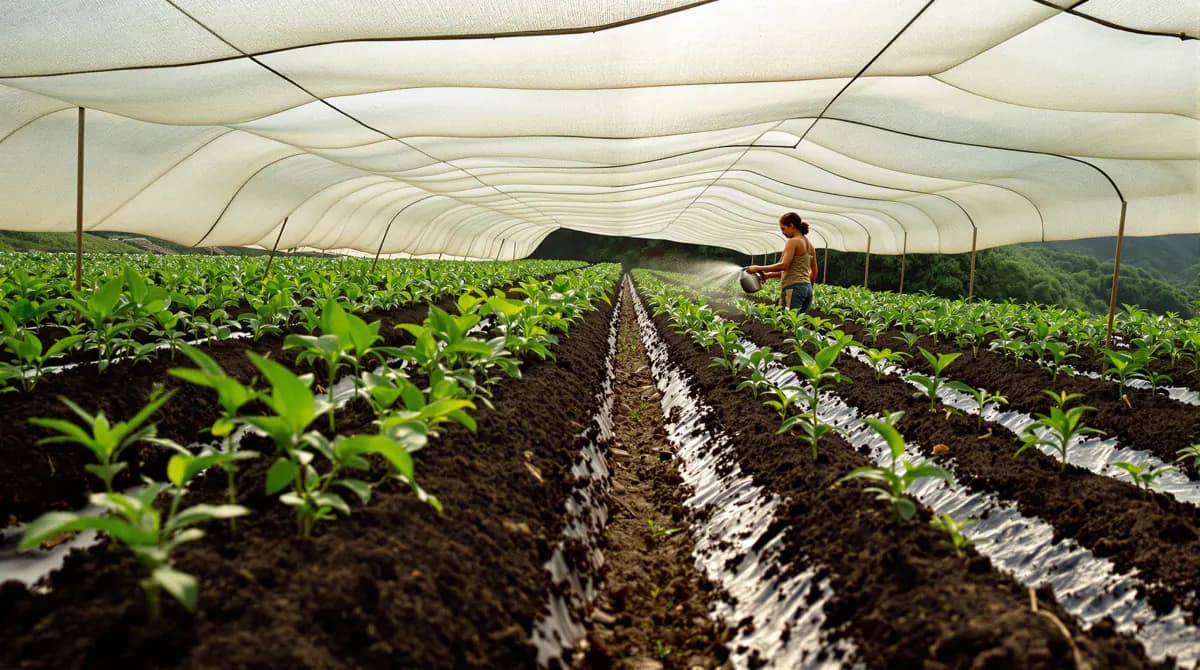
In the second quarter of 2025, the first seedling beds went in on the estate at Rivera, in the Andean valley of Huila. There was nothing photogenic about it. Beds had to be levelled, substrate mixed, shade arranged so that young plants would not be cooked by the midday sun or drowned by an afternoon downpour. Rivera is a small town, coffee country is close by, and everyone here knows that a slope does one of two things with rain: it drinks it, or it loses it. The nursery is our attempt to put that choice back in our hands.
Why grow our own
It would have been faster to buy seedlings. It would also have been the wrong decision.
Restoration work only holds if the plants belong to the place. Native species already know this valley's rhythm — its dry weeks, its heavy afternoons, its soils. They feed insects and birds that evolved alongside them. Bought-in stock of unknown origin can survive a season and then quietly fail, and by the time you find out, the planting window has closed.
Growing our own also means we control the timing. A corridor planting has to happen when the ground is ready, not when a supplier has stock. And it means the knowledge stays on the estate: how a given seed behaves, how long it sits before it wakes up, which beds it prefers. That is the real output of a first year — not only plants, but a working memory of them.
We are deliberately not publishing species counts yet. The list is still being verified alongside the field records, and we would rather say less and be right. [FIGURE TO CONFIRM]
What a first year actually looks like
Most of the first year was repetition. Collect. Sow. Water. Shade. Watch. Discard what fails. Sow again.
The work settled into a small set of routines that now run without anyone announcing them:
- Seed collected locally, from the valley rather than from a catalogue, so the stock stays native to the site.
- Beds prepared and sorted by how much shade and water each batch needs.
- Losses recorded rather than hidden, because a failed batch is information about the next one.
- Seedlings held until they are strong enough to face a hillside, not shipped out at the first sign of green.
- Planting-out timed to the ground, then followed up rather than forgotten.
None of that is dramatic. All of it is why there is something to plant.
From the beds to the corridor
The nursery exists to serve a purpose beyond itself. In the third quarter, planting on the wildlife corridor linked two forest fragments that had been separated — two patches of forest that animals could see across but not safely cross.
Those plantings were fed by the beds. That is the whole logic of the operation: a corridor is not a line drawn on a map, it is a great many individual plants, each of which has to survive its own first dry spell. The nursery is what stands between an intention and a living hedgerow of trees.
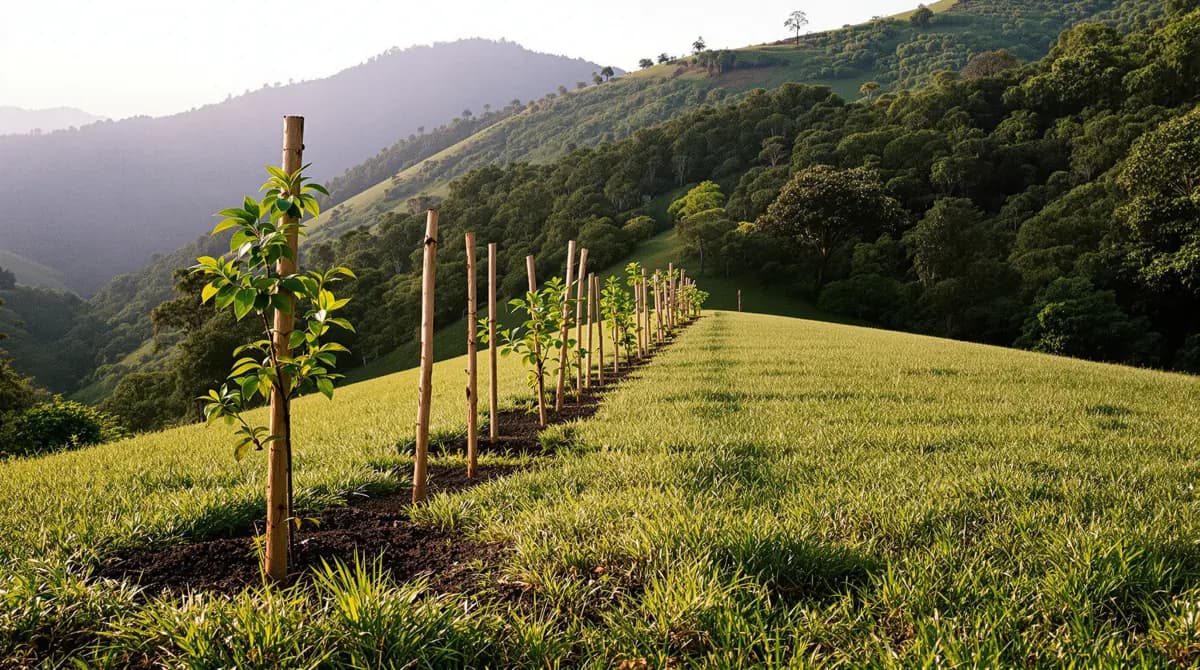
And the corridor is not the only place the work shows. On one hillside of the estate we have before-and-after photographs of the restoration. The difference is visible enough that we do not need to describe it in adjectives — the ground cover holds, the slope looks less like an open wound.
We are being careful about what we claim on fauna. Linking fragments gives animals room to move, forage and breed across a larger area, and that is well established as a principle. What species are using this particular corridor, in what numbers, is something we will report when we have observation data worth reporting — not before.
What the second year has to prove
A first year proves that a nursery can be built. A second year has to prove that it can be sustained: consistent germination, less loss, and enough volume that the corridor planting is never limited by what is on the benches.
The nursery is funded under the ecological restoration pillar, which took the largest share of the 2025 budget. Those are management figures for 2025 and are not yet audited; the audited statement will be published in due course.
What twenty euros does
We are often asked what a small donation actually buys, and we prefer to answer concretely rather than emotionally.
Based on our 2025 field costs, and offered as an illustration rather than a price list, 20 € covers roughly a dozen native seedlings — grown, planted and tracked. Tracked matters as much as planted. A seedling in the ground is a hope; a seedling that someone comes back to check on is restoration.
A dozen at a time is how this valley gets stitched back together.

 Regeneration