
Community
Paid to Learn: Rivera's First Training Cohort
Phoenix Initiative4 min read
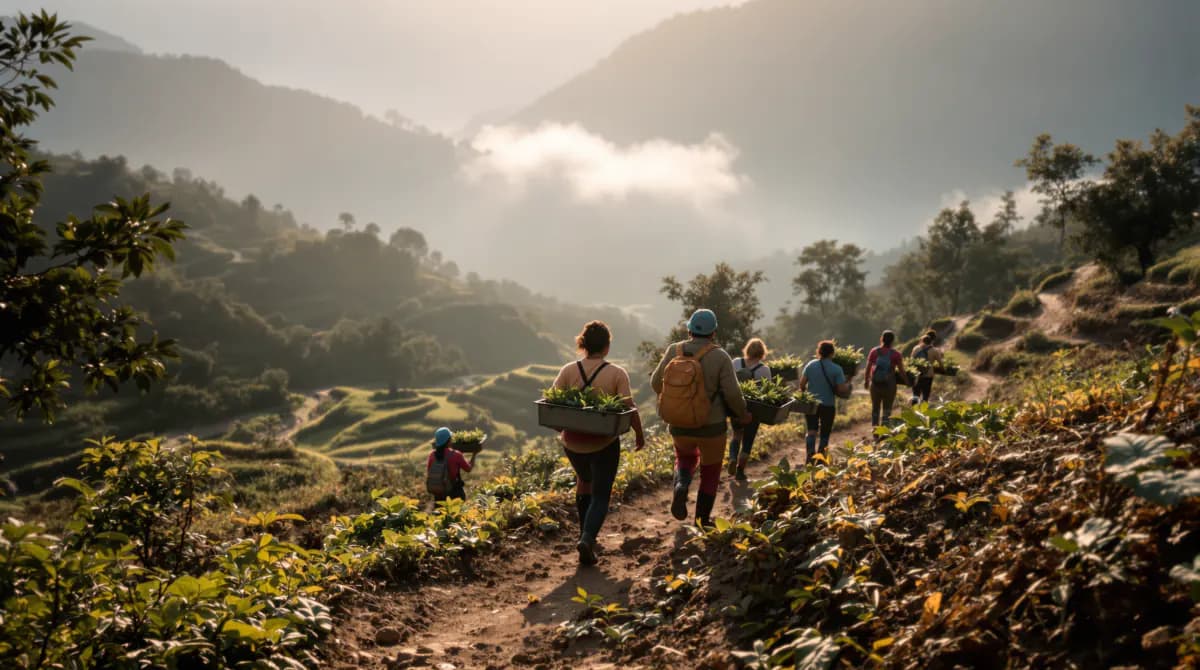
In the second quarter of 2025, two things began almost at the same time on the foundation's land in Huila: the first seedling beds of the nursery, and the first paid training cohort of women from Rivera. That was not a coincidence. A nursery is not built out of seedlings alone; it is built out of hands that know how to keep them alive.
This article is about the second of those beginnings, and about a single word in its description that we chose deliberately: paid.
What the cohort trains in
The training is anchored in the two kinds of work the foundation is doing on the ground this year: nursery work and ecological restoration.
On the nursery side, that means the daily craft of raising native plants: preparing beds, caring for young seedlings, and learning to follow them over time, because a seedling that is planted and then forgotten tells you nothing. Tracking is what turns planting into restoration.
On the restoration side, the training points toward the hillsides themselves. The foundation has been restoring a hillside on its Huila estate, and this quarter the planting of a wildlife corridor is underway to link two fragments of forest. Work like that needs people who can do it well, close to home, season after season.
We are deliberately not describing a curriculum in more detail than the work itself justifies. The training is practical, and it happens where the plants are.
Why “paid” is the important word
Most training programs, in most places, ask one thing of participants before anything else: free time. And free time is the resource that is distributed most unfairly.
A day spent in training is a day not spent earning, and not spent on the many kinds of unpaid work that already fill many women's days. When training is unpaid, it quietly filters its participants. It selects for those who can afford to give a day away, and the people with the least room in their lives are the first ones excluded, even when the training was designed with them in mind.
Paying for training days reverses that filter. It says: your time is a real cost, and we will treat it as one. It also changes the nature of the relationship. A paid trainee is not a beneficiary receiving a favor; she is a worker acquiring a skill. That distinction is what dignity looks like in practice, and it shapes everything from attendance to the quality of the questions asked.
There is a colder argument too, and we hold it alongside the warmer one. Restoration is long. Forests do not recover on the timescale of a workshop. If the skills are going to stay in Rivera, in the nursery and on the hillsides and along the corridor, then training has to be something a person can build part of a livelihood around, not something squeezed between obligations.
What a training day costs
We publish field-cost equivalences so that supporters can picture what their contribution does. These are illustrative, based on 2025 field costs, not a price list:
- about 50 € corresponds to one training day for one woman of the cohort;
- about 20 € corresponds to a dozen native seedlings planted and tracked, the kind of work the cohort is being trained to do.
We are not publishing the size of this first cohort here; that figure belongs with the year's consolidated reporting. What we can say is qualitative but real: it is a first group, it is made up of women from Rivera, and “first” is the operative word. The point of a first cohort is to learn, together with its participants, how to run the next one better.
What this makes possible
The quiet ambition behind the cohort is that the knowledge should live in the town, not in the foundation. Seedling beds need care every week of the year. A corridor between two forest fragments will need watching long after the planting teams have moved on. The most durable way to guarantee that is for the skills, and the paid work that goes with them, to belong to people who are already home.
That is the whole design: local land, local hands, and training treated as work because it is work. The seedlings in the new beds will say, in a few years, whether we did it well.