
Fieldwork
A hillside, before and after
Phoenix Initiative4 min read
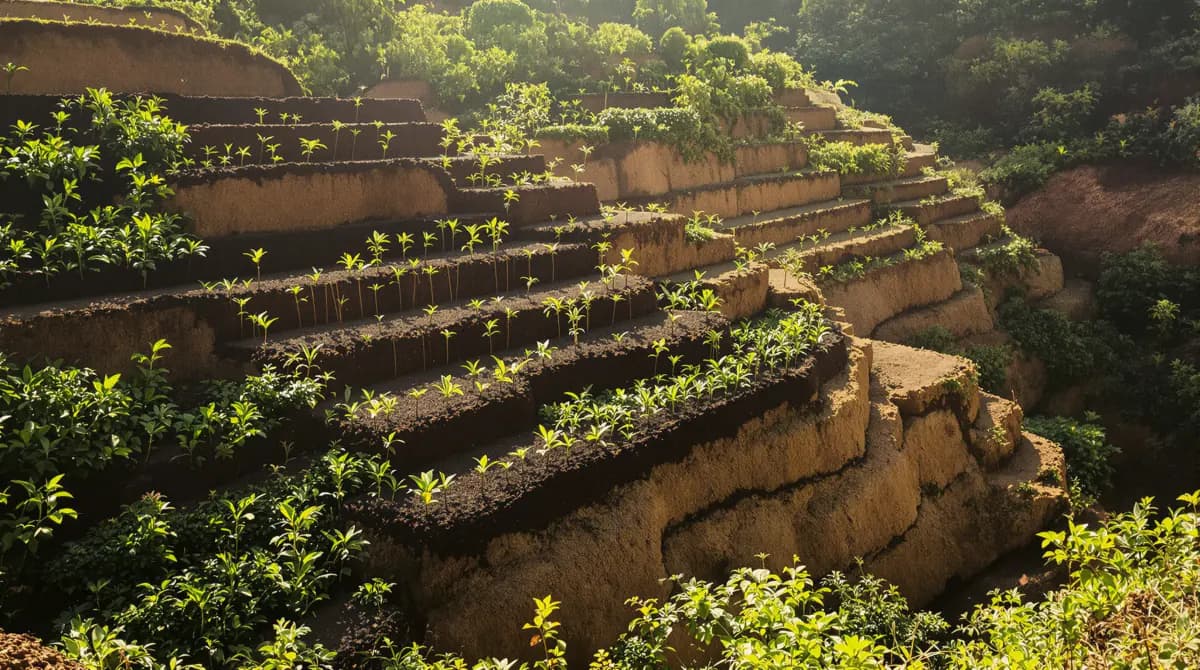
There is a hillside on the foundation's estate near Rivera, in Colombia's Huila department, that we have photographed again and again from the same vantage points. Two sets of images now sit side by side: one from before the restoration work began, one from after a season of soil work and planting. Between those two sets of photographs lies most of what our ecological restoration pillar actually does.
What the "before" looked like
The first photographs are not dramatic, and that is part of the point. They show a degraded slope of a kind found throughout the Andean foothills: soil exposed and compacted, vegetation thinned to scattered patches, and the unmistakable signature of erosion — small channels carved by runoff, earth slumping where roots no longer held it in place. Nothing about the hillside was beyond repair. It was simply losing ground, in the most literal sense, a little more with each heavy rain.
Degradation of this kind rarely announces itself. It accumulates quietly. A slope stops holding water, then stops holding soil, then stops supporting the plants that would have held both. Reversing that spiral, patch by patch, is what restoration means in practice.
The work
The work itself was deliberate and unspectacular. It began with the soil: preparing the slope so that rain would slow down and soak in rather than race downhill carrying earth with it. Stabilising the ground came before anything green.
Then came the planting. The seedlings were grown a short distance away, in the foundation's own nursery, whose first seedling beds were established in the second quarter of 2025. Native seedlings raised there were planted out across the slope, and each planting is tracked over time — because putting a plant in the ground is the easy part, and survival through the seasons is the real measure of the work.
None of this happened quickly, and none of it is finished. A hillside does not recover on a communications schedule, and we will not pretend otherwise.
What the "after" photographs show
The second set of images shows the same slope, framed from the same spots, holding together. There is green cover where there was bare earth. Young plants stand where runoff used to cut channels. The contours have not changed; what covers them has.
We want to be precise about what these photographs are and are not. They are not a finish line. Restoration is measured in years, and an "after" photo is only a waypoint — next year's image should look different again, and better. What the photographs do show is direction: a slope that was losing soil is now keeping it.
Restoration as slow proof
There is a temptation, in this kind of work, to reach for spectacle. We prefer repetition. The same slope, the same angles, season after season. Photographs taken this way are hard to argue with and hard to fake, and that is exactly why we use them.
They are also a form of accountability. When someone gives to the foundation, they are entitled to see what their support becomes — not in slogans, but in ground. This journal exists partly for that reason, and the hillside series is its plainest example: here is what the slope looked like, here is the work that was done, here is what it looks like now. The foundation shows its work; it does not sell it.
What it cost, and a caveat
In 2025, ecological restoration received 52,500 USD — 35% of the 150,000 USD the foundation received during the year, and the largest share of any pillar. These are management figures for 2025, not yet audited; the audited statement will be published once the review is complete, and this journal will link to it.
For a sense of scale, one illustrative equivalence based on 2025 field costs: around 20 € corresponds to a dozen native seedlings planted and tracked. A hillside is made of very many such dozens.
One slope on one estate does not restore a valley. But it demonstrates the method the pillar applies wherever it works: prepare the ground, plant from the nursery, track what survives, and photograph honestly from the same place — before, during, and after. The next set of photographs is already scheduled. We will publish those too.