
Bio-construction
Guadua: Building with a Bamboo That Grows Here
Phoenix Initiative4 min read
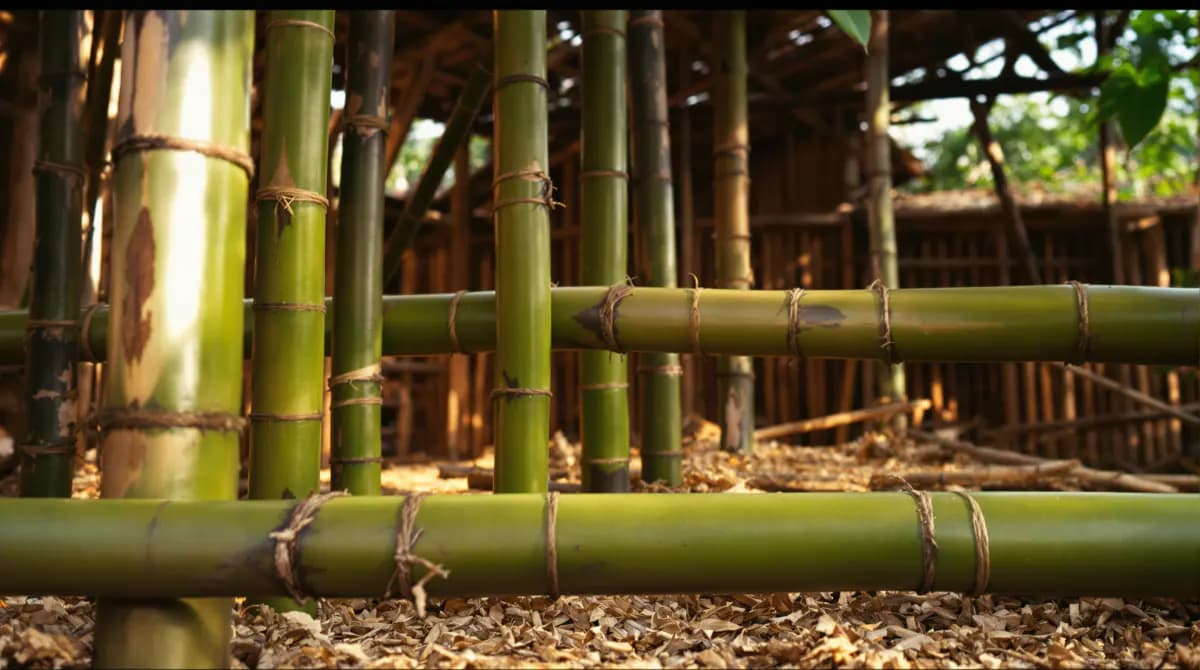
In Rivera, a small town set in an Andean valley of Huila, Colombia, most new construction follows the same recipe: cement blocks, steel rebar, metal roofing, all trucked in from somewhere else. On the land where Foundation Phoenix works, a different material sets the tone. It grows a few steps away, it has held up rural houses in this country for generations, and it asks very little of the planet. It is called guadua.
A bamboo of this valley
Guadua is a native bamboo, one of the large bamboos of the Americas. It thrives in the humid folds of the Andes, along creeks and on hillsides, in the same landscapes that hold the region's coffee country and thermal springs. Around Rivera it is not an exotic curiosity; it is part of the vegetation people grew up with.
It is also part of how people here have long built. Across the Colombian countryside, guadua has served as posts, beams, walls and bridges for generations. Choosing it is not an imported innovation. It is a decision to continue, and to take seriously, a local building culture that concrete had pushed aside.
Why we build with it
When the foundation raises a structure — a shelter, a roof, the frame of a shared space — guadua is the rule, not the exception. The reasons are simple and practical:
- It is renewable. A stand of guadua is harvested cane by cane. Cut a mature culm and the plant keeps living and sending up new shoots; there is no clear-cutting, no bare ground left behind.
- It is local. The material comes from nearby, which means short transport, no long supply chains, and money that stays in the region. Just as important, the know-how is local too: cutting, curing and joining guadua are skills that exist here.
- It is low-carbon. Qualitatively, the contrast with cement and steel is stark. Guadua grows by capturing carbon; it needs no furnace, no mine and no cargo ship to become a building material.
There is a quieter reason as well. A guadua building suits this climate: light structures, shaded and ventilated, that do not fight the valley's heat with machinery but work around it.
One of five pillars
Building this way is not a side interest. It is one of the foundation's five pillars, the one called eco-responsible infrastructure. In 2025, out of the 150,000 USD the foundation received, 30,000 USD — 20% — went to this pillar. One important caveat: these are management figures for 2025, not yet audited. The split still awaits validation, and the audited financial statement will be published once it is ready.
Within that envelope, the principle stays constant: build only what the mission needs, and build it in a way the land can carry. No structure exists for its own sake; each one serves the nursery, the training work, the workshops or the daily functioning of the site.
Water, the companion work
The same pillar carries a second line of work: autonomous water systems. A building made of the right material still fails the test if everything that supplies it comes from far away and at a high cost. So alongside the guadua structures, the foundation works on systems that let the site manage its own water with more independence — capturing it, storing it, using it carefully.
The two efforts belong together. Guadua answers the question "what do we build with?"; the water systems answer "what keeps it running?". Both point in the same direction: infrastructure that stands lightly on its place.
Building the way we restore
A few hundred meters from the newest guadua posts, the foundation is restoring a hillside; the before-and-after photos tell that story better than words could. It would be strange to replant a slope with native species and then pour concrete at the foot of it. The construction choices and the restoration work follow the same logic: use what the land offers, give back more than is taken, and let the place remain recognizable to itself.
That is what guadua stands for on this site. Not nostalgia, and not a trend, but a sober bet: that in an Andean valley, the most responsible building material is the one that grows there.
(As with all 2025 finances mentioned here: management figures, not yet audited; the audited statement will follow.)